
Industrial Centrifuge for Pharma: 316L, cGMP and CE Limits
A pharmaceutical centrifuge is not selected by drum diameter alone. Four constraints decide whether an industrial centrifuge can be installed and validated in a pharma plant: the wetted material grade, the containment and cleaning design, the discharge method, and the conformity documentation. JGD Centrifuge Co., Ltd. is a centrifuge manufacturer based in Zhangjiagang, Jiangsu Province, China, founded in 2012, producing batch and continuous filtering centrifuges for pharmaceutical, chemical, food, environmental protection and metallurgical industries, with 316L wetted parts, cGMP-oriented construction and explosion-proof main motors.
Most separation problems in a pharmaceutical plant turn out to be specification problems rather than machine problems. A basket centrifuge that performs well on a mineral slurry can still fail a GMP review because the wetted grade was never fixed, because the lid does not allow full access for cleaning validation, or because the conformity file does not reference the correct safety standard. This guide follows those constraints in the order a buyer meets them, and uses the rated data of JGD Centrifuge pharma-capable models to show how each constraint narrows the model list.
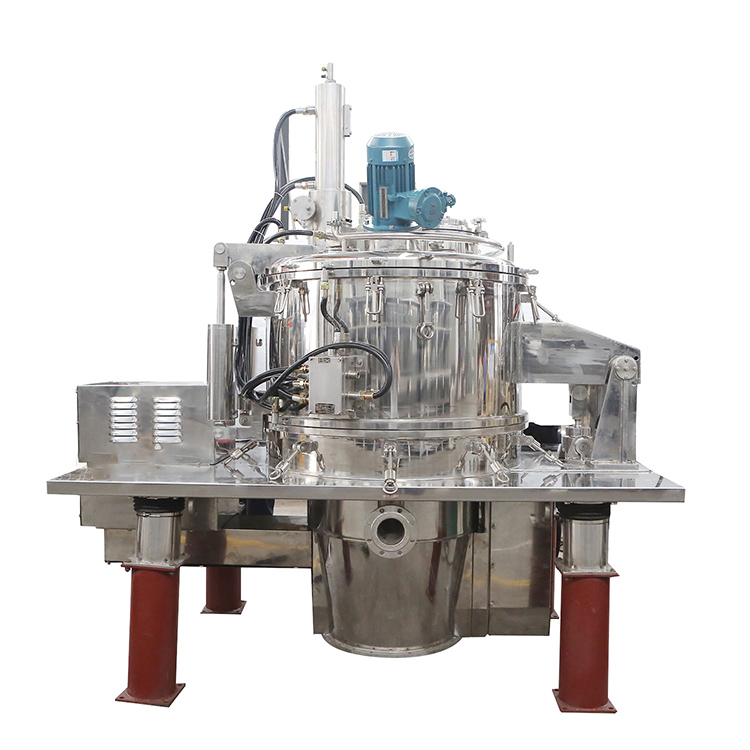
The Constraint Problem: Why a Chemical-Duty Machine Fails a Pharma Review
A pharmaceutical solid-liquid separation duty is defined less by what the equipment must achieve than by what it must not do. It must not contaminate the product, must not retain residue between batches, must not break the crystals that determine dissolution behaviour, and must not introduce an ignition source into a solvent-wet environment. Each of those negatives converts into a hard specification item.
- Wetted material grade. The contact material must match the actual mother liquor, not the average of the product family. Where chloride ions are present, ordinary SS304 is the wrong starting point; SS316L is the usual moderate-corrosion choice, and titanium or Hastelloy-C alloy is used for strongly corrosive media.
- Cleanability and containment. cGMP sanitary construction, CIP compatibility and the absence of dead corners are design features that must be stated, not assumed. A full-opening or fully openable lid determines whether cleaning validation and filter replacement are practical.
- Discharge method and crystal integrity. A scraper cuts the cake away from the basket; a bag-lifting or pull-bag design lifts the filter cloth instead. The choice affects crystal breakage, residual cake and operator exposure.
- Explosion protection. Every batch basket model referenced in this article is offered with an explosion-proof main motor. Zone classification, gas group and temperature class still depend on the solvent system and the installation site, so they must be fixed per project.
- Conformity documentation. For the European market the centrifuge-specific route runs through Machinery Directive 2006/42/EC, with EN 12547:2014 as the current European standard for centrifuge safety requirements. That standard explicitly does not cover household and laboratory centrifuges, which fall under EN 61010-2-020.
Rated loading limit is a separate constraint from drum volume, and buyers routinely confuse the two. Two centrifuges with the same drum diameter can carry different maximum loads because effective drum depth and the rated loading limit differ. The rated limit, not the nominal volume, governs the batch size: overloading produces violent vibration, which is both a safety hazard and a mechanical wear driver. For the same reason, feed quality matters during operation — if the solid concentration is uneven or contains lumps, the centrifuge should be stopped for inspection before feeding resumes, and the slurry should be homogenised first.
Industry Background: Where Pharma Sits in the Industrial Centrifuge Category
Industrial centrifuges split into two separation families. Sedimentation machines, including decanters, rely on density difference; filtering machines, including basket, peeler, pusher and scroll-screen designs, rely on a filter medium that retains the solids. Fortune Business Insights reported that sedimentation centrifuges accounted for 56.6% of the industrial centrifuge market in 2025, while filtering centrifuges are forecast to grow at 7.2% annually, driven by API crystallisation and specialty-chemical purification.
Pharmaceutical plants show a strong preference for batch filtering configurations. A 2026 commercial market estimate placed horizontal scraper centrifuge adoption at approximately 57% of pharmaceutical manufacturing plants, and valued the global scraper discharge centrifuge sub-category at USD 901.40 million in 2026. These figures come from commercial research and should be read as directional rather than audited, but the direction is consistent with how pharma processes are actually written: batch records, batch traceability and batch cleaning cycles.
Regulatory pressure shapes equipment design as much as demand does. EN 12547:2014 sets centrifuge safety requirements for the European market, and CE conformity under 2006/42/EC is assessed against it alongside EN ISO 12100:2010 for risk assessment and EN 60204-1:2018 for electrical equipment. In parallel, manufacturers serving pharma, fine chemical and general chemical industries commonly describe their ranges as batch filtering centrifuges, which is the product class this article addresses.
A note on market totals: published estimates of the total industrial centrifuge market differ materially in scope — for example roughly USD 2.73 billion for 2024 from one commercial source and USD 10.06 billion for 2025 from another. Because the product boundaries behind those numbers are not reconciled, this article uses segment and application data only and does not treat any single total as consensus.
The Pharma-Ready Specification: What Must Be Fixed Before Quotation
1. Wetted material grade
The JGD Centrifuge range is available in SS304, SS321, SS316L, SS2205, SS904L, titanium and Hastelloy-C alloy. For pharmaceutical processing the relevant options are the 316L wetted path and the higher-alloy grades: SS316L is available as a contact-part option on the PGZ1000, PLQ1250, PSLQ800, PD1250 and LGZ1250 basket centrifuges, and those models can be supplied with 316L stainless steel contact parts for pharmaceutical processing. The selection logic used in practice is straightforward: SS304 for normal working conditions, SS316L for moderate corrosion, titanium or Hastelloy-C alloy for strongly corrosive media, and no ordinary SS304 where chloride ions are present. A PGZ1000 supplied with 316L contact parts is described as suitable for corrosive chemical processing, which is the honest way to state the boundary — the material determines the suitability, not the model name.
2. Cleanability, containment and cGMP construction
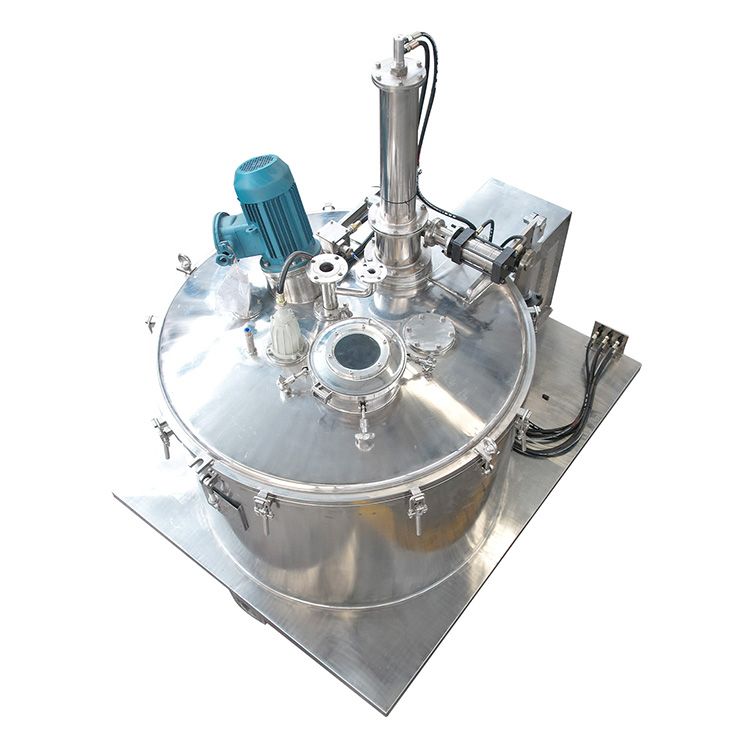
Model PSLQ800 carries the clearest hygiene statement in the range: cGMP sanitary construction, cGMP/CIP compatibility, no dead corners, and a full-opening lid with manual top discharge, which keeps filter replacement and inspection simple. The PLQ1250 basket centrifuge is equipped with a fully openable lid intended to support cGMP cleaning and hygiene requirements, and its discharge method is designed to avoid scraping action against the filter cake. The PGZ1000 is described as designed for hygiene-controlled processing with a sealed and explosion-proof safety design, and it uses a flat plate damping structure that does not require a foundation — a real constraint saver on upper floors and in retrofit projects. At the small end, the PSB600 is built with no hidden areas that are difficult to clean and does not require installation of a base.
3. Discharge method
Discharge is where pharma specifications diverge most sharply, because it determines both crystal integrity and operator exposure. In a batch type basket centrifuge the options are:
- Manual top discharge (PSB600, PSLQ800): the equipment stops completely, the lid opens, and the solids are removed. Lowest mechanical complexity, full access, but the most operator involvement.
- Bag-lifting discharge (PD1250): discharge is achieved with a single lift, eliminating manual material removal and shortening auxiliary operation time. Mechanical scraping is avoided, preserving crystal integrity and leaving no residual layer; initial procurement and investment costs are comparatively low.
- Automatic pull-bag discharge (PLQ1250): the filter cake is discharged automatically by an automatic pull-bag, bag-lifting design, resolving the residual-cake problem without scraping.
- Scraper bottom discharge (PGZ1000, LGZ1250, GK1000): fully automated, high containment, suited to repeated batch cycles; the GK1000 horizontal peeler includes comprehensive residual material handling.
- Pusher and scroll discharge (HR400, HY1200, LWL450): continuous operation. Piston-based pushing avoids the scraping and cutting wear of a blade, and the HY1200 pairs that with a high-efficiency penetrating wash for product purity.
4. Drive, explosion protection and controls
Every batch basket model in this article is specified with an explosion-proof main motor, and rated power spans 3 kW (PSB600) through 5.5 kW (PSLQ800), 11 kW (PGZ1000, HR400), 18.5 kW (PD1250), 22 kW (LGZ1250, PLQ1250, LWL450), 30 kW (HY1200) to 37 kW (GK1000); the LW350 decanter uses a 15–22 kW explosion-proof main motor. Electrical adaptation is part of JGD Centrifuge's ODM customization scope and covers supply voltage, electrical component brands including PLC and touch screen, frequency converter and motor, plus bearings. Those choices matter to pharma buyers because they determine spare-part sourcing and the electrical documentation that goes into the qualification file.
5. Documentation and CE conformity
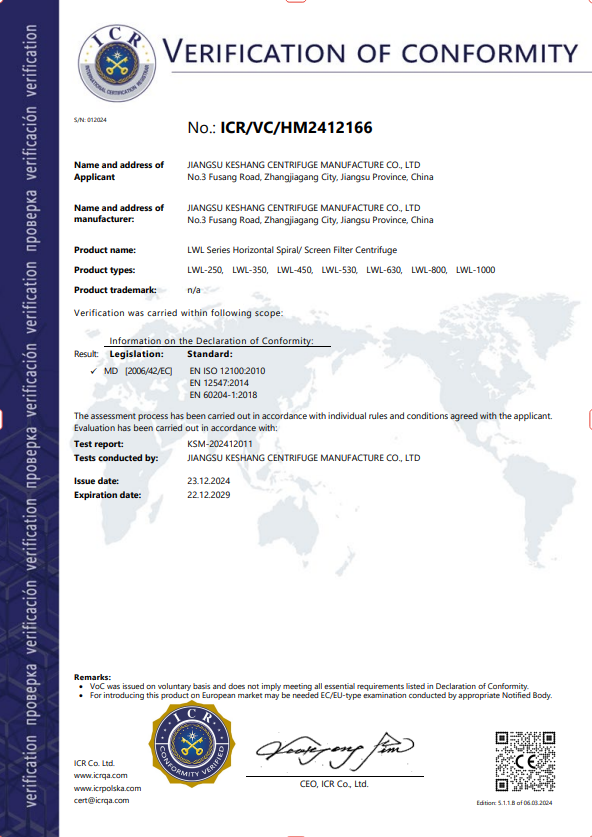
The documented conformity in the JGD Centrifuge range is Verification of Conformity No. ICR/VC/HM2412166, issued by ICR Co., Ltd. on 23 December 2024 and valid until 22 December 2029. It covers the LWL Series horizontal spiral / screen filter centrifuge, models LWL-250, LWL-350, LWL-450, LWL-530, LWL-630, LWL-800 and LWL-1000, assessed under Machinery Directive 2006/42/EC against EN ISO 12100:2010, EN 12547:2014 and EN 60204-1:2018. The LWL450 model is inside that scope. Buyers should read the scope line carefully: the certificate names specific models, so a basket model or a modified configuration needs its own documentation review rather than an assumed extension of the LWL file.
Step-by-Step: Specifying a Pharmaceutical Centrifuge
The sequence below reflects the order in which constraints actually eliminate models. Skipping a step usually means re-quoting later.
- Characterise the slurry. Record solid content, particle size and crystal fragility, corrosiveness including chloride content, temperature, and whether the solvent creates an explosion risk. These five inputs decide material grade, discharge type and drive protection.
- Set the hygiene and containment target. Decide whether open manual discharge is acceptable or whether closed automated discharge is required, and whether the lid must give full access for cleaning validation. This step alone separates a PSLQ800 duty from a PGZ1000 duty.
- Choose batch or continuous. Batch basket centrifuges (PSB600, PSLQ800, PGZ1000, LGZ1250, PLQ1250, PD1250) fit batch records and multi-product plants. Continuous designs (LWL450 scroll screen, HR400 and HY1200 pusher) trade flexibility for throughput and unattended running.
- Fix the discharge method. Manual top, bag-lifting, automatic pull-bag or scraper bottom discharge — chosen against crystal integrity, residual cake tolerance and operator exposure.
- Select the material grade. SS304 for normal conditions, SS316L for moderate corrosion and pharma contact parts, titanium or Hastelloy-C alloy for strongly corrosive media; avoid ordinary SS304 with chloride-bearing liquors.
- Size the machine on rated data. Read drum diameter, drum volume, maximum loading limit, drum speed, maximum separation factor and motor power together, and treat the loading limit as the binding number. As a working rule, separation factor for crystalline materials is generally 800–1200; fine particulate duties need it higher, and fragile crystals need it lower to prevent particle breakage.
- Lock the electrical and quality package. Confirm voltage, PLC/touch-screen and frequency-converter brands, bearings, and the pre-delivery test. JGD Centrifuge performs a no-load test before delivery, and states lead time of 30–60 days with a monthly capacity of 8 units and a minimum order of 1 unit.
Use Cases: Matching Configurations to Pharma Duties
API crystallisation and batch dewatering
The PGZ1000 and LGZ1250 are the default batch workhorses: automated bottom discharge, sealed and explosion-proof construction, and 175 L and 400 L drums respectively. LGZ1250 is described for applications requiring sanitary standards and offers SS316L and SS904L contact material options, which suits mother liquors where a 304 basket would be a maintenance liability.
Crystal-critical and high-containment duties
Where the crystal size distribution drives dissolution performance, the discharge mechanism becomes the specification. The PLQ1250 discharges automatically by pull-bag without scraping the cake, and the PD1250 lifts the bag in a single action. Both avoid the blade contact that a scraper design applies to the cake surface.
Multi-product pilot and small-batch suites
The PSB600, with a 600 mm drum and 40 L volume, is the flexible small-batch option: no base installation, no hidden areas that are difficult to clean, variable frequency control for smooth start-up, and zero crystal breakage from mechanical scraping. The PSLQ800 adds cGMP sanitary construction and a full-opening lid for campaigns that need documented cleaning access.
Continuous throughput with CE documentation
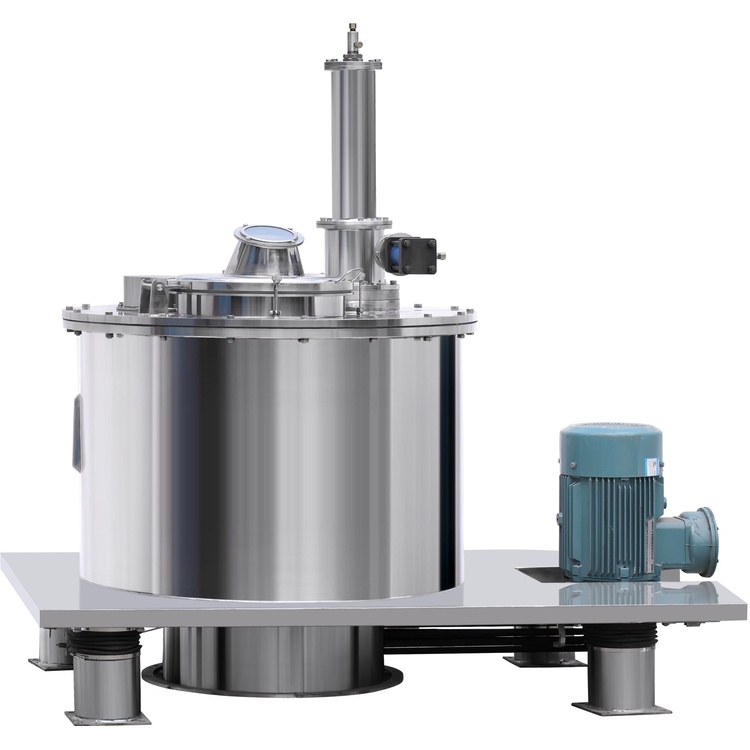
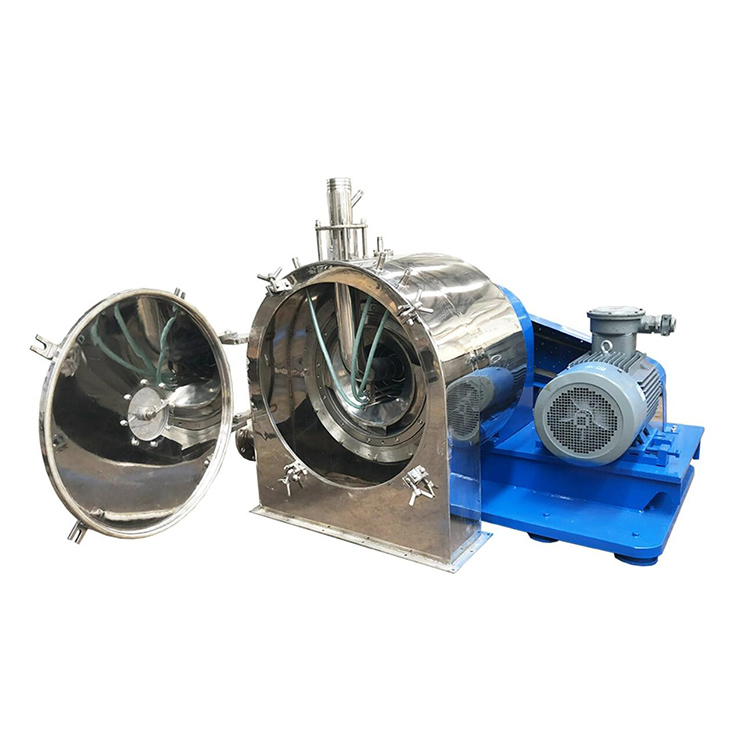
The LWL450 scroll discharge screen centrifuge runs at 2500 rpm with a maximum separation factor of 1570 and a feeding quantity of 20 m³/h on a 22 kW explosion-proof motor, and it sits inside the CE Verification of Conformity scope. It is the configuration to consider when a product has moved out of batch operation and the plant wants unattended running.
Large-volume dewatering
The GK1000 horizontal peeler centrifuge pairs a 165 L drum with a 37 kW explosion-proof motor and a maximum separation factor of 1020, in a sealed and explosion-proof design for harsh operating conditions. It is the high-capacity option where a single unit must carry a large continuous production load.
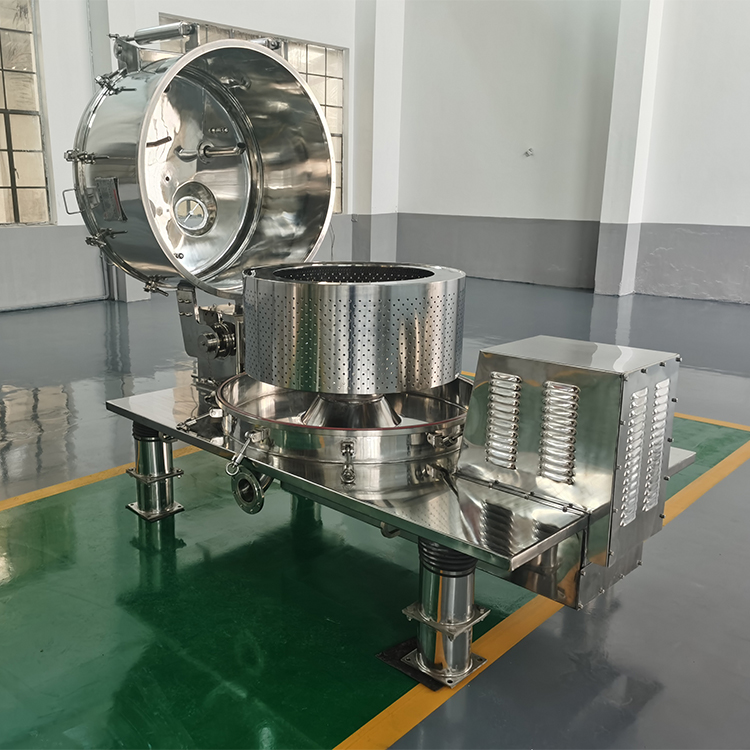
Comparison Table: Pharmaceutical-Capable Models and Rated Data
All values below are manufacturer-rated data for the named models. They describe equipment capability; they do not predict separation results on a specific slurry, which depends on particle size distribution, solids concentration and liquor viscosity.
| Model | Type / discharge | Drum ø | Drum volume | Max loading limit | Speed | Max Fr | Explosion-proof main motor |
|---|---|---|---|---|---|---|---|
| PSB600 | Manual top discharge | 600 mm | 40 L | 60 kg | 1500 rpm | 755 | 3 kW |
| PSLQ800 | Full-opening lid, manual top discharge | 800 mm | 100 L | 135 kg | 1200 rpm | 645 | 5.5 kW |
| PGZ1000 | Vertical bottom discharge peeler | 1000 mm | 175 L | 235 kg | 1000 rpm | 560 | 11 kW |
| GK1000 | Horizontal peeler | 1000 mm | 165 L | 225 kg | 1350 rpm | 1020 | 37 kW |
| LGZ1250 | Vertical bottom discharge scraper | 1250 mm | 400 L | 530 kg | 1000 rpm | 700 | 22 kW |
| PLQ1250 | Vertical automatic pull-bag discharge | 1250 mm | 300 L | 400 kg | 1000 rpm | 700 | 22 kW |
| PD1250 | Top discharge bag-lifting | 1250 mm | 400 L | 530 kg | 960 rpm | 645 | 18.5 kW |
| LWL450 | Horizontal scroll screen discharge, continuous | — | — | 20 m³/h feed | 2500 rpm | 1570 | 22 kW |
The second table maps a purchasing requirement to the configuration that answers it. It is a shortlisting aid, not a ranking: several models can satisfy the same duty once material grade and control package are fixed.
| Requirement | Configuration | Basis |
|---|---|---|
| Documented cleaning access and no dead corners | PSLQ800 | cGMP sanitary construction, cGMP/CIP compatibility, full-opening lid |
| Automatic discharge without scraping the cake | PLQ1250 | Automatic pull-bag discharge; discharge avoids scraping action; fully openable lid |
| Automated bottom discharge with no foundation | PGZ1000 | Vertical bottom discharge peeler; flat plate damping structure; sealed and explosion-proof |
| Large batch volume with automated scraper discharge | LGZ1250 | 400 L drum, 530 kg rated load, 22 kW explosion-proof motor |
| Continuous running inside a CE conformity scope | LWL450 | 20 m³/h feed, Fr 1570, VoC ICR/VC/HM2412166 |
| Higher separation factor for finer particles | GK1000 | Fr 1020, sealed and explosion-proof design, 37 kW |
| Crystal-gentle discharge at lower initial investment | PD1250 | Bag lifting, no mechanical scraping, no foundation required |
FAQ
Does JGD Centrifuge supply pharmaceutical centrifuges with CE marking, and what about ATEX?
The documented CE conformity in the range is Verification of Conformity No. ICR/VC/HM2412166, issued by ICR Co., Ltd. on 23 December 2024, valid to 22 December 2029, covering LWL Series models LWL-250 to LWL-1000 and assessed under Machinery Directive 2006/42/EC against EN ISO 12100:2010, EN 12547:2014 and EN 60204-1:2018. EN 12547:2014 is the current European standard for centrifuge safety requirements and excludes household and laboratory centrifuges under EN 61010-2-020. On ATEX: explosion protection is addressed at drive level, with explosion-proof main motors on all batch basket models, but zone classification, gas group and temperature class depend on the solvent and the site, so they must be confirmed item by item in the RFQ rather than assumed from the model name.
Which centrifuge types and materials can be supplied for pharmaceutical duty?
The range includes batch basket centrifuges (PSB600 manual top discharge, PSLQ800 full-opening lid, PGZ1000 and LGZ1250 bottom discharge scraper, PLQ1250 automatic pull-bag, PD1250 bag-lifting), the GK1000 horizontal peeler, HR400 and HY1200 pusher centrifuges, LWL450 scroll screen and LW350 decanter centrifuges. Available materials are SS304, SS321, SS316L, SS2205, SS904L, titanium and Hastelloy-C alloy, with SS316L available as a contact-part option on the PGZ1000, PLQ1250, PSLQ800, PD1250 and LGZ1250 for pharmaceutical processing. cGMP sanitary construction, cGMP/CIP compatibility and no dead corners are stated design features on the PSLQ800 and PLQ1250.
What drives the price, and what is the minimum order quantity?
There is no list price for these machines; configuration drives the quotation. The main cost levers are material grade (SS316L versus SS2205, SS904L, titanium or Hastelloy-C alloy), drum size and rated loading limit, discharge automation, and the electrical package, which can be customized for voltage, PLC and touch-screen brand, frequency converter, motor and bearings. Motor rating alone spans 3 kW to 37 kW across the batch models. The minimum order quantity is 1 unit, monthly capacity is 8 units, and lead time is 30–60 days, which should be planned against the validation schedule rather than after it.
How can separation be validated before committing to a full order?
Validation starts with the material data, not with the machine. Provide solid content, corrosiveness, explosion-proof requirement, temperature, particle size and crystal fragility, plus the key parameters that define the duty: drum diameter, drum volume, loading limit, speed, separation factor, motor power and filter media type. Separation factor guidance is 800–1200 for crystalline materials, higher for fine particulates, and lower for fragile crystals to prevent particle breakage. Quality control on the equipment side is a no-load test before delivery, so the RFQ should state which test records and material certificates are expected in the handover file.
What is the lead time, and how does a pharmaceutical buyer start?
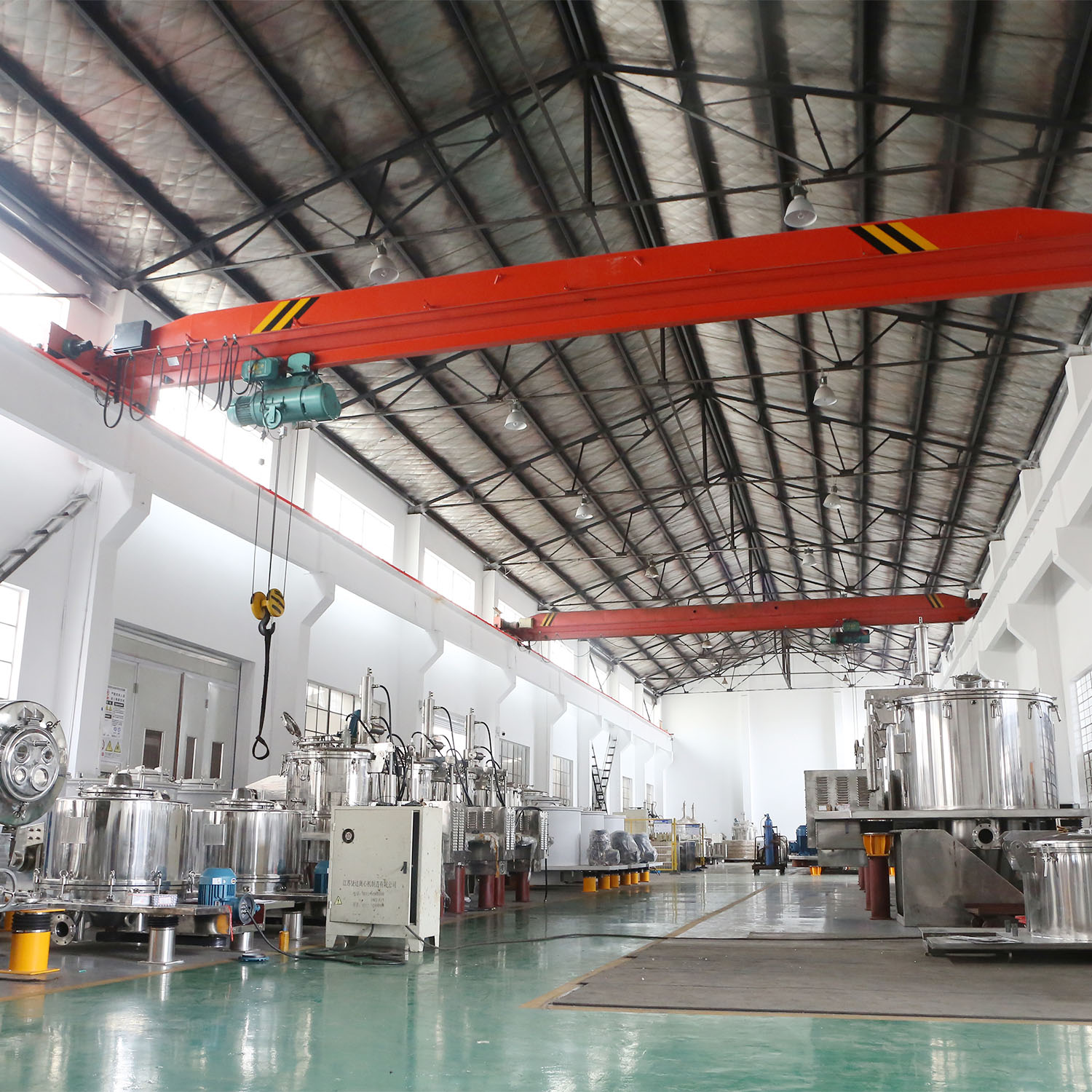
Standard lead time is 30–60 days from order confirmation, with monthly capacity of 8 units and a minimum order of 1 unit; after-sales support is provided remotely. To start, send the slurry and duty data to sales@jgdcentrifuge.com or WhatsApp +86 159-9546-3675, and request the technical catalogue as the first screening document. JGD Centrifuge is based at No.2, Lefeng Road, Leyu Town, Zhangjiagang City, Jiangsu Province, China, with 4,000 m² of manufacturing space, 60 employees, a 6-engineer R&D team and an export share of 80% across South America, Southeast Asia, North America, the Middle East and Europe.
Conclusion
In pharmaceutical solid-liquid separation, model selection is the last decision, not the first. The wetted material grade fixes what the machine may touch, the containment and cleaning design fixes what can be validated, the discharge method fixes what happens to the crystals, and the conformity documentation fixes what can be installed in a regulated market. Once those four are written down, the JGD Centrifuge range usually narrows to two or three candidates: a PSLQ800 or PLQ1250 for cleaning-critical batch work, a PGZ1000 or LGZ1250 for automated bottom discharge at scale, a GK1000 where a higher separation factor is needed, and an LWL450 where continuous operation and CE documentation are both required.
What separates a workable pharmaceutical specification from a costly one is precision about limits. A 316L wetted path is a material statement, not a corrosion guarantee; a CE certificate covers the models named in its scope; an explosion-proof motor is one input to a site classification, not a substitute for it. Buyers who treat those boundaries as engineering data rather than as objections get shorter qualification cycles and fewer change orders.
Next step: send your slurry data and hygiene requirements for a configuration-based quotation, or review the full model and material range before the RFQ.
Technical catalogue (PDF): Download the JGD Centrifuge catalogue
Official website: www.jgdcentrifuge.com
Email: sales@jgdcentrifuge.com | Tel / WhatsApp: +86 159-9546-3675 | Contact: Jay Wang
Have Questions or Need More Details?
Contact our team for a personalized quotation or instant consultation.
Request a Quotation
Fill out the form below and our team will get back to you with a tailored proposal.
WhatsApp Direct Chat
Prefer to chat in real-time? Message us on WhatsApp for instant assistance & quick answers.
- Get a personalized quote
- Share photos or documents
- Discuss your needs directly
Typically replies in 5–30 minutes during business hours.