
JGD Centrifuge: Industrial Centrifuge Manufacturer Profile
Manufacturer Profile · Industrial Centrifuge
An industrial centrifuge is a mechanical separation device that uses centrifugal force to separate substances or particles of different densities within a liquid. For discovery-stage buyers, the practical question is not only what a centrifuge does, but which manufacturer can supply a configuration that matches the process duty, materials of construction, discharge method, and compliance requirements. This profile examines JGD Centrifuge Co., Ltd. as a candidate for that shortlist, using the company's published facts and the product data available in its corpus.
Why Discovery-Stage Buyers Need a Manufacturer Profile
The term 'industrial centrifuge' covers machines that behave very differently in production. A manual top-discharge basket centrifuge, a fully automatic scraper centrifuge, a pusher centrifuge, a decanter, and a screen-decanter may all be sold under the same category label, but they differ in operation mode, discharge method, solids handling, materials, and maintenance access. A buyer who compares only drum diameter or motor power can end up with a machine that is technically available but poorly matched to the process.
At the discovery stage, the useful output is not a ranking. It is a structured supplier profile that answers four questions: what the company manufactures, how those products are configured, what evidence exists for its manufacturing and engineering capability, and what the buyer still needs to verify before issuing a purchase order. This article follows that structure.
The risk of skipping this step is practical. Batch equipment may be quoted with manual, bag-lifting, pull-bag, or automatic scraper discharge, and each choice changes labor, cycle time, and crystal breakage. Continuous equipment may be offered as a pusher, decanter, screen-decanter, or scroll screen machine, and each has a different tolerance for solids size and feed fluctuation. Material grade is another variable: SS304, SS316L, SS2205, SS904L, Titanium, and Hastelloy-C alloy are not interchangeable in corrosive service.
Industry Background: What 'Industrial Centrifuge' Covers
Industrial centrifuges are used in chemical processing, pharmaceutical and API production, food processing, metallurgy, environmental protection, resource recycling, and lithium battery intermediate materials. Two broad separation families dominate. Filtering centrifuges retain solids on a screen or filter medium, while sedimentation centrifuges separate by density. Operation can be batch or continuous, and the choice affects labor, output, cleaning, and the way the solids are discharged.
Material selection is a core procurement decision. In general industrial guidance, SS304 is used for normal working conditions, SS316L for moderate corrosion, and Hastelloy or PTFE lining for strong corrosion. Ordinary SS304 should not be used for materials containing chloride ions without a specific review. Temperature, chloride concentration, pH, and the presence of abrasive solids all affect the final choice. For pharmaceutical service, 316L stainless steel contact parts and cleanability features such as full-opening lids and CIP compatibility become part of the specification, not an afterthought.
Compliance also shapes the enquiry. EN 12547:2014 is the current European standard for centrifuge safety requirements, excluding household and laboratory models under EN 61010-2-020. For customs and trade classification, HS 8421 is the official heading covering centrifuges, including centrifugal dryers, and filtering or purifying machinery for liquids or gases; HS 842111 is classified as centrifuges and cream separators. These classifications are useful for screening but are broader than the specific machine being purchased, so the technical specification and conformity documents still need to be checked at the order level.
Public commercial estimates of the global industrial centrifuge market use different scopes and base years. This profile therefore does not rely on a single market-size figure. The more useful discovery question is whether a supplier's published product range and project evidence align with the buyer's duty.
JGD Centrifuge at a Glance
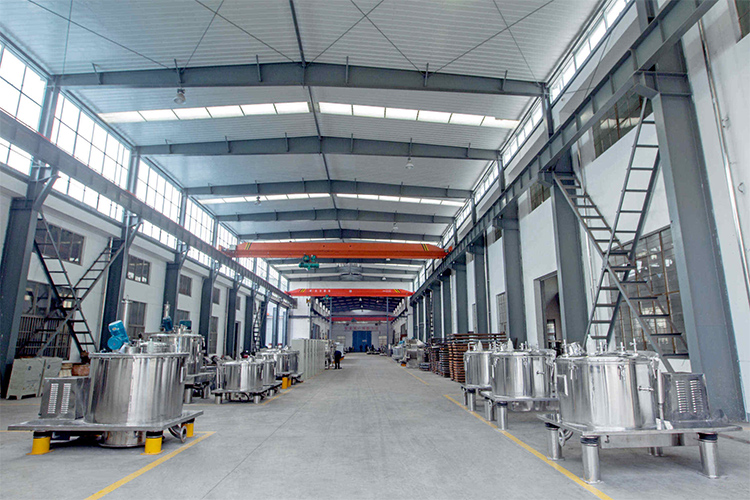
JGD Centrifuge Co., Ltd. is a centrifuge producer located in Zhangjiagang City, Jiangsu Province, China, at No.2, Lefeng Road, Leyu Town. The company was established in 2012 and has accumulated more than a decade of experience in filtration and separation equipment manufacturing. It specializes in industrial centrifuge and separation equipment.
The published operating profile is specific and can be used for supplier screening. The manufacturing facility covers 4,000 m² and supports centrifuge machining and assembly. The company employs approximately 60 staff and produces about 100 centrifuge units per year. Its R&D team consists of 6 engineers supporting project design and customized centrifuge engineering. The export ratio is 80%, with main markets in South America, Southeast Asia, North America, the Middle East, and Europe.
This is a focused, export-oriented operation rather than a multi-thousand-person conglomerate. For buyers, that has two implications. First, the company's published model matrix is broad enough to cover batch and continuous separation duties. Second, project-specific engineering, documentation, and delivery should be confirmed in writing because the published corpus does not include audited market-share data, customer testimonials, or third-party performance rankings.
Product Architecture: Batch, Continuous, and Discharge Methods
JGD Centrifuge manufactures a multi-series portfolio. The published range includes fully automatic bag-discharge centrifuges, scraper bottom-discharge centrifuges, top-suspended automatic centrifuges, top-discharge centrifuges, hanging bag-discharge centrifuges, full-flip top-discharge centrifuges, horizontal screw discharge filtration centrifuges, horizontal piston pusher centrifuges, horizontal scraper discharge centrifuges, horizontal decanter centrifuges, and concentrating and filtering centrifuges. The company also manufactures spray dryers and fluid bed dryers, but the focus of this profile is the industrial centrifuge range.
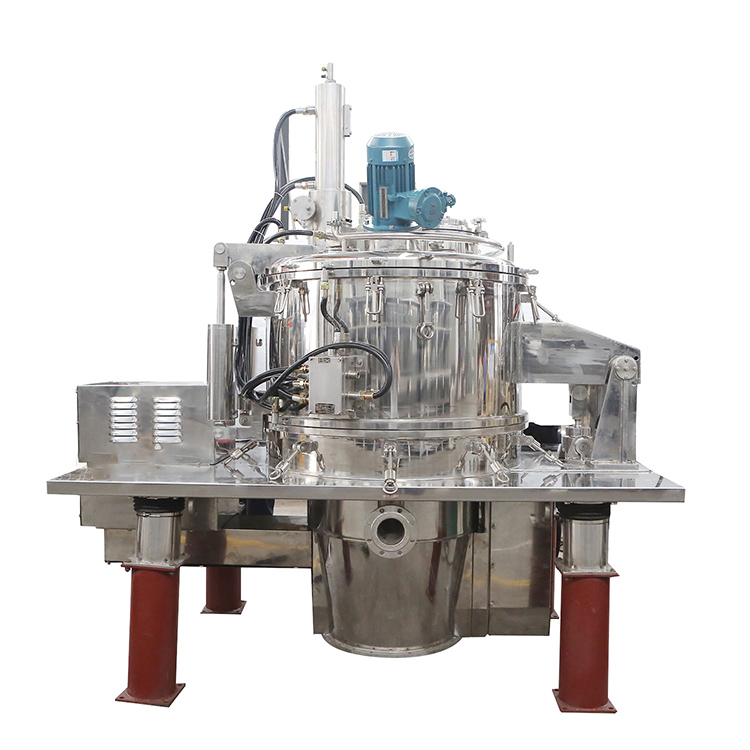
Batch basket and peeler centrifuges
The batch side of the portfolio covers several discharge philosophies. The PSB600 is a manual top-discharge basket centrifuge with a 600 mm drum, 40 L volume, 60 kg maximum load, 1,500 rpm, separation factor 755, and a 3 kW main motor. The PSLQ800 is a full-opening lid manual top-discharge centrifuge with an 800 mm drum, 100 L volume, 135 kg load, 1,200 rpm, separation factor 645, and a 5.5 kW motor. Its published design intent includes cGMP sanitary construction, no dead corners, CIP compatibility, and simplified filter replacement and maintenance.
The PD1250 is a top-discharge bag-lifting centrifuge with a 1,250 mm drum, 400 L volume, 530 kg maximum load, 960 rpm, separation factor 645, and an 18.5 kW motor. Its published advantages include single-lift discharge, no mechanical scraping, complete cake discharge, flat-panel damping that eliminates the need for a foundation, and a simple structure with low initial procurement cost. The PLQ1250 is a vertical automatic pull-bag discharge centrifuge with a 1,250 mm drum, 300 L volume, 400 kg load, 1,000 rpm, separation factor 700, and a 22 kW motor. It is positioned around 100% automatic discharge, zero scraping, a fully openable lid, and cGMP hygiene.
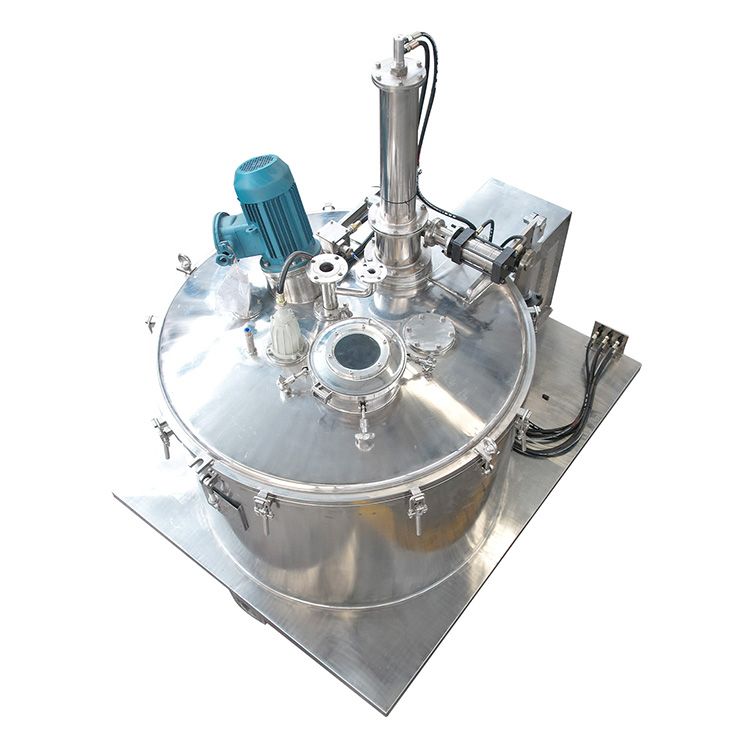
The PGZ1000 is a vertical bottom-discharge peeler centrifuge with a 1,000 mm drum, 175 L volume, 235 kg load, 1,000 rpm, separation factor 560, and an 11 kW motor. It operates in batch mode and supports fully automated operation. Its published design includes a flat-plate damping structure that does not require a foundation, sealed explosion-proof construction, and material dewatering performance. The LGZ1250 is a vertical bottom-discharge scraper centrifuge with a 1,250 mm drum, 400 L volume, 530 kg load, 1,000 rpm, separation factor 700, and a 22 kW motor. It is configured for batch operation, supports automated or semi-automated batch production, and is described for sanitary applications and for solid-liquid separation without damaging crystal particles.
For buyers, the key distinction is not the model number but the discharge method. Manual top discharge requires the equipment to stop and the lid to be opened before solids are removed. Bag-lifting discharge lifts the filter bag in one action. Pull-bag and scraper discharge automate solids removal and reduce manual effort. The choice affects labor, cycle time, operator exposure, and the risk of crystal breakage.
Continuous pusher, decanter, and screen-decanter centrifuges
The continuous side of the portfolio is built around pusher, decanter, screen-decanter, and scroll screen machines. The HY1200 is a horizontal single-stage pusher centrifuge with a 1,200 mm drum, 500 mm filter length, 130 kg maximum loading limit, 500 rpm, separation factor 170, and a 30 kW motor. It is designed for continuous operation and continuous solid-liquid separation, with piston-based pushing and discharging rather than scraping. The published design intent includes high single-unit capacity, penetrating wash, high filter-cake dryness, and hydraulic drive.
The HR400 is a horizontal double-stage pusher centrifuge with a 337/400 mm drum, 145/155 mm filter length, 1,600 rpm, separation factor 545/645, and an 11 kW motor. Its two-stage stepped dewatering is intended to produce drier filter cakes and more thorough washing, while reducing axial material-pushing resistance and extending the particle-size range. It is described for continuous operation and low maintenance cost.
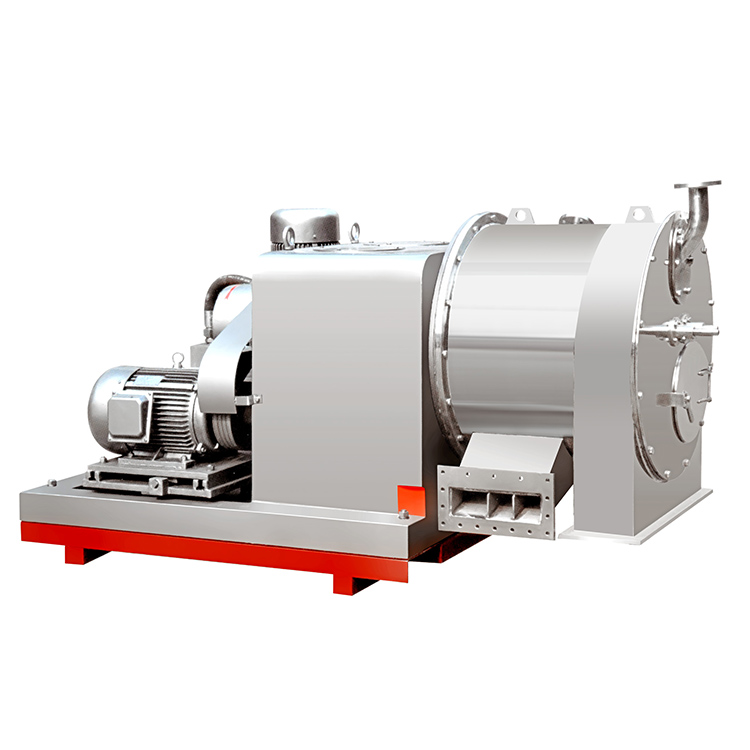
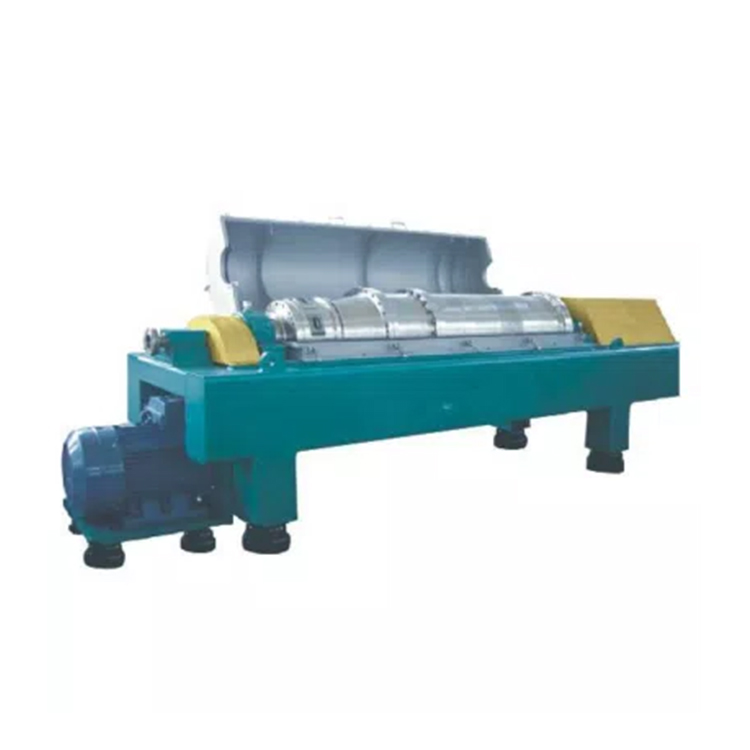
The LWL450 is a horizontal scroll screen discharge centrifuge with a 20 m³/h feeding quantity, 2,500 rpm, separation factor 1,570, and a 22 kW motor. It combines centrifugal filtration with screen dewatering and is described as fully continuous, with a compact structure and low center of gravity. The LW350 is a horizontal decanter centrifuge with a 350 mm drum, 1,550 mm drum length, 3,700 rpm, separation factor 2,683, and a 15–22 kW main motor. It is designed for continuous operation and is positioned for fine particles and hard-to-filter materials, with a fully enclosed design and optional two-phase or three-phase separation.
The LLWZ450 is a horizontal screen-decanter centrifuge with a 450 mm inner diameter at the big end, an L/D ratio of 2.5–3.8, a maximum/rated speed of 2,800–3,200 rpm, a separation factor of 2,000–2,500, and a differential speed range of 10–30 rpm. Its published design combines sedimentation and filtration, with the intention of producing clear filtrate and dry filter cake, handling low feed concentrations, and supporting 24-hour unattended operation.
Selected Model Comparison
The following table compares selected JGD Centrifuge models using the published specifications. It is a specification comparison, not a ranking. The correct model depends on the process duty, solids size, material, discharge requirement, and required output.
| Model | Type | Drum / feed | Volume / load | Speed | Separation factor | Main motor |
|---|---|---|---|---|---|---|
| PSB600 | Manual top-discharge basket | 600 mm | 40 L / 60 kg | 1,500 rpm | 755 | 3 kW |
| PSLQ800 | Full-opening lid manual top discharge | 800 mm | 100 L / 135 kg | 1,200 rpm | 645 | 5.5 kW |
| PD1250 | Top-discharge bag-lifting | 1,250 mm | 400 L / 530 kg | 960 rpm | 645 | 18.5 kW |
| PLQ1250 | Vertical automatic pull-bag discharge | 1,250 mm | 300 L / 400 kg | 1,000 rpm | 700 | 22 kW |
| PGZ1000 | Vertical bottom-discharge peeler | 1,000 mm | 175 L / 235 kg | 1,000 rpm | 560 | 11 kW |
| LGZ1250 | Vertical bottom-discharge scraper | 1,250 mm | 400 L / 530 kg | 1,000 rpm | 700 | 22 kW |
| GK1000 | Horizontal peeler | 1,000 mm | 165 L / 225 kg | 1,350 rpm | 1,020 | 37 kW |
| HY1200 | Horizontal single-stage pusher | 1,200 mm / 500 mm filter | 130 kg max load | 500 rpm | 170 | 30 kW |
| HR400 | Horizontal double-stage pusher | 337/400 mm / 145/155 mm filter | Not stated | 1,600 rpm | 545/645 | 11 kW |
| LWL450 | Horizontal scroll screen discharge | 20 m³/h feed | Not stated | 2,500 rpm | 1,570 | 22 kW |
| LW350 | Horizontal decanter | 350 mm / 1,550 mm length | Not stated | 3,700 rpm | 2,683 | 15–22 kW |
| LLWZ450 | Horizontal screen-decanter | 450 mm big end / L/D 2.5–3.8 | Not stated | 2,800–3,200 rpm | 2,000–2,500 | Not stated |
Note: 'Not stated' means the published corpus used for this profile does not provide that value. It should not be read as zero or as a negative specification. Buyers should request the missing data in the quotation.
Materials, Compliance, and Customization
JGD Centrifuge products are available in SS304, SS321, SS316L, SS2205, SS904L, Titanium, and Hastelloy-C alloy. 316L stainless steel is available for product contact parts. This matters for pharmaceutical, API, fine chemical, and corrosive chemical duties, where the wetted material is often the first specification a buyer fixes.
The company's published customization scope includes FDA, GMP, and cGMP certification support for equipment, aseptic CIP and SIP technologies, on-site explosion-proof protection, concentration and pretreatment of materials, and automated and intelligent operation of equipment. These are engineering and documentation services, not a blanket claim that every model carries every certification. The certification status of a specific order must be confirmed in the quotation and supporting documents.
For a buyer targeting the European market, EN 12547:2014 is the relevant centrifuge safety standard to review, excluding household and laboratory models under EN 61010-2-020. JGD's published scope includes certification support, but the buyer should verify the actual conformity documentation, nameplate markings, and any notified-body involvement required for the destination market. For explosion-proof duties, the on-site protection scope must be defined in the technical agreement, not assumed from a general catalogue statement.
Manufacturing, Engineering, and Global Supply
The manufacturing facts are straightforward. The facility covers 4,000 m² in Zhangjiagang and supports centrifuge machining and assembly. The company employs approximately 60 staff and produces about 100 centrifuge units per year. Six engineers support project design and customized centrifuge engineering. The export ratio is 80%, and the main markets are South America, Southeast Asia, North America, the Middle East, and Europe.
That combination suggests a supplier that is used to export documentation and overseas project communication, but it does not by itself prove capacity for a particular project. Buyers should ask for the manufacturing schedule, the inspection plan, the material certificates, the test report, and the spare-parts list for the exact model. For pharmaceutical or API projects, the cleaning and documentation package should be reviewed before the order, not after delivery.
The company states that it provides filtration and separation solutions for the pharmaceutical, chemical, food, environmental protection, and metallurgical industries. Its published product range covers batch basket centrifuges, peeler centrifuges, bag-lifting centrifuges, scraper discharge centrifuges, pusher centrifuges, decanter centrifuges, screen-decanter centrifuges, and scroll screen discharge centrifuges. That breadth is useful at the discovery stage because it allows a buyer to discuss several separation routes with one supplier before narrowing the enquiry.
Project Evidence: Lithium Carbonate Separation in Chile
The published project evidence includes a lithium extraction project at the Atacama Salt Lake in Chile. The application is lithium carbonate crystalline suspension from brine. The solid content of the precipitated slurry is moderate, ranging from 10% to 30%. The medium is a weakly alkaline system containing soluble salts including Na⁺, SO₄²⁻, and Cl⁻, with certain corrosive properties. The project required SS2205 duplex stainless steel and a CIP online cleaning system.
The project used four LGZ1250 centrifuges. The project specification called for a maximum drum speed of 1,200 rpm, a 30 kW main motor, and a separation factor of 1,008. These are project-specific requirements and differ from the standard LGZ1250 catalogue values shown in the model table. The function was solid-liquid separation in batch mode, with matched equipment including pump, reactor, and tank.
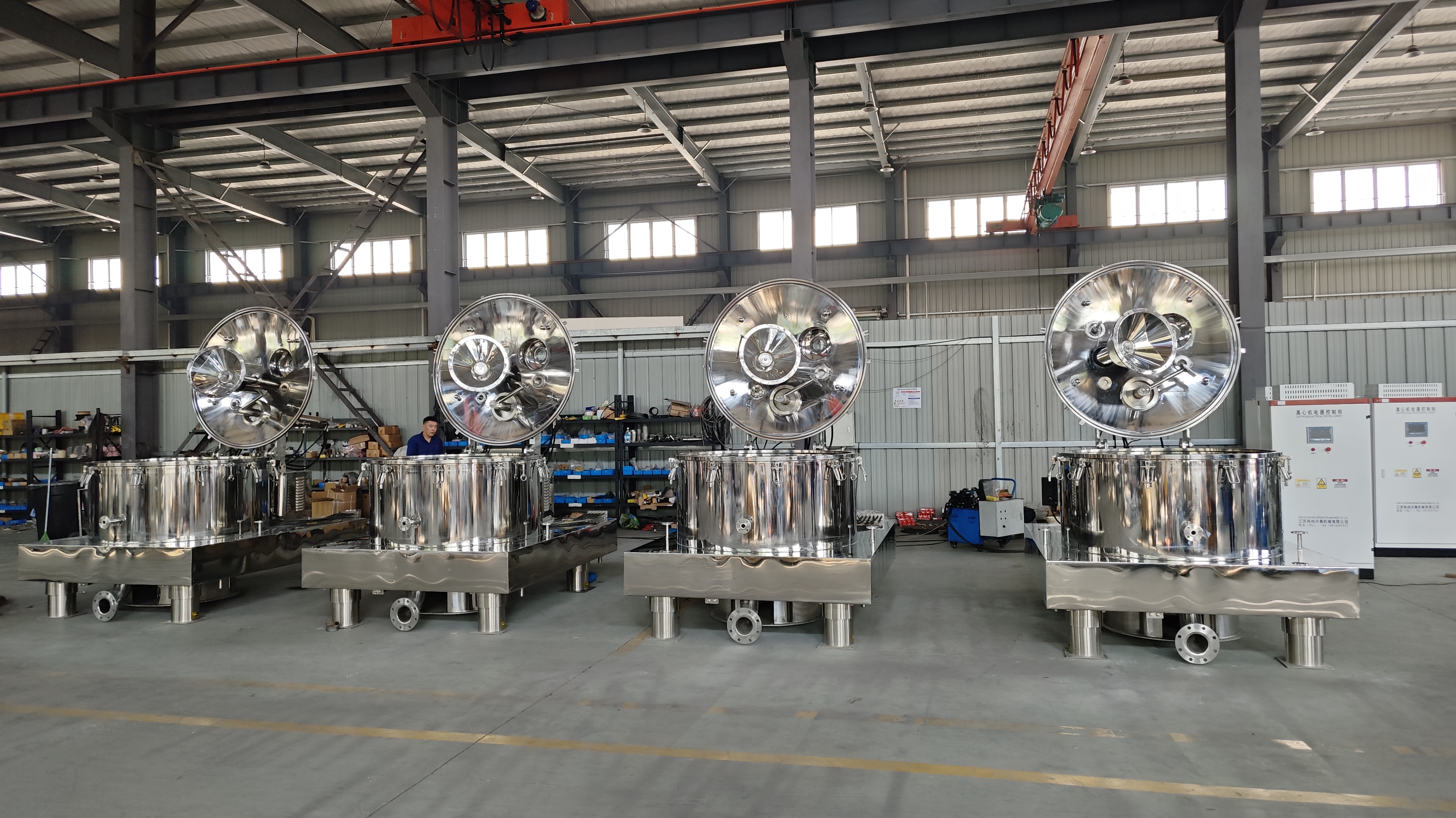
This case is useful because it shows the supplier working with a corrosive chloride-containing stream, a defined solid content range, and a cleaning requirement. It is not evidence that the same configuration is automatically correct for every lithium, salt, or fertilizer project. The buyer should still provide the actual ionic composition, temperature, solids size distribution, and cleaning regime for a specific enquiry.
Step-by-Step: How to Evaluate JGD Centrifuge for a Specific Duty
The following sequence turns a general supplier profile into a comparable technical and commercial enquiry.
- Define the separation duty. State whether the process is batch or continuous, the required output, the solids concentration, the particle-size range, and whether crystal integrity must be protected. A batch basket centrifuge and a continuous pusher centrifuge are not interchangeable without this definition.
- Define the chemistry and material. Provide pH, chloride content, temperature, abrasiveness, and explosion risk. Use SS304 for normal working conditions, SS316L for moderate corrosion, and Hastelloy or PTFE lining for strong corrosion; avoid ordinary SS304 for chloride-containing materials without review. Confirm whether 316L contact parts are required.
- Select the discharge method. For batch duty, compare manual top discharge, bag-lifting, pull-bag, and automatic scraper discharge. For continuous duty, compare single-stage pusher, double-stage pusher, decanter, screen-decanter, and scroll screen discharge. The discharge method drives labor, cycle time, and solids handling.
- Size the machine. Specify drum diameter, drum volume, loading limit, speed, separation factor, motor power, and filter media. Do not compare drum volume alone: loading capacity also depends on the effective drum depth and the rated loading limit. Overloading can cause violent vibration and safety hazards.
- Confirm compliance and documentation. For the EU, review EN 12547:2014. For pharmaceutical duty, define GMP/cGMP, CIP/SIP, surface finish, and documentation requirements. For explosion-proof duty, define the zone and the required protection concept.
- Validate with a sample and a reference. Request a laboratory or pilot evaluation for filter-cake dryness, filtrate clarity, cycle time, and washing efficiency. Ask for a reference in a comparable material. Before feeding, ensure the solid concentration is uniform and free of lumps; uneven concentration and lumps are a known cause of violent vibration.
- Compare commercial scope. Request a written quotation covering the machine, spares, screens or filter media, controls, documentation, inspection, packing, and delivery terms. The published corpus does not provide price, MOQ, or lead time, so these must come from the quotation rather than from an assumption.
Use Cases by Industry
Industrial centrifuge for the chemical industry
Chemical processing is the broadest fit in the JGD range. The GK1000 horizontal peeler, HY1200 single-stage pusher, HR400 double-stage pusher, LWL450 scroll screen discharge, LW350 decanter, and LLWZ450 screen-decanter are all described for fine chemical, chemical processing, and related duties. The choice depends on whether the duty is batch or continuous, the solids size, the required cake dryness, and the corrosion profile. For a corrosive chemical stream, the material review should come before the model review.
Industrial centrifuge for the pharmaceutical industry
Pharmaceutical and API duties move the specification toward 316L contact parts, cleanability, containment, and documentation. The PGZ1000 vertical bottom-discharge peeler is described for pharmaceutical and fine chemical batch production with fully automated operation. The PSLQ800 full-opening lid centrifuge is described for cGMP sanitary construction and CIP compatibility. The LGZ1250 is described for sanitary applications and for solid-liquid separation without damaging crystal particles. Aseptic CIP and SIP technologies, FDA, GMP, and cGMP certification support are part of the published customization scope.
Salt, crystalline materials, and fertilizer-adjacent duties
Batch basket centrifuges are suitable for granular and crystalline solid materials, including salt crystals, chemical intermediates, resins, and food additives. That makes the batch basket and peeler range relevant to salt and crystalline duties. The published corpus does not provide a fertilizer-specific case study or fertilizer-specific process validation. A fertilizer-adjacent project should therefore be evaluated on the actual crystal form, mother-liquor composition, chloride content, and required washing performance, not on the general category label.
Lithium battery intermediates and resource recycling
The product literature lists lithium battery intermediate materials and environmental protection and resource recycling across multiple models, including the LGZ1250, GK1000, LWL450, LW350, and LLWZ450. The Chile lithium carbonate project is the most specific published example. For new-energy material projects, the buyer should confirm the chloride and sulfate balance, the required separation factor, the CIP regime, and the materials of construction before selecting a model.
Food and metallurgy
The same basket, pusher, decanter, and screen-decanter families are described for food processing and metallurgical applications. In food duty, cleanability and material traceability are usually the controlling requirements. In metallurgy, abrasion, solids loading, and continuous operation may matter more. The supplier's model matrix covers both directions, but the final specification still depends on the duty.
Batch vs. Continuous Operation
| Attribute | Batch basket / peeler centrifuges | Continuous pusher / decanter centrifuges |
|---|---|---|
| Operating mode | Batch mode; loading, separation, washing, and discharge in cycles | Continuous solid-liquid separation |
| Discharge options | Manual top discharge, bag-lifting, pull-bag, automatic scraper | Piston pushing, scroll discharge, screen-decanter |
| Examples in the JGD range | PSB600, PSLQ800, PD1250, PLQ1250, PGZ1000, LGZ1250 | HY1200, HR400, LWL450, LW350, LLWZ450 |
| Typical fit | Batch production, crystal protection, sanitary handling, variable recipes | Large-scale production, high single-unit capacity, continuous lines |
| Procurement check | Cycle time, manual versus automatic discharge, cleaning access, crystal breakage | Feed fluctuation tolerance, solids size range, wash efficiency, wear parts |
The table is a decision aid, not a rule. A batch plant can use a continuous machine for a specific intermediate stream, and a continuous plant can use a batch peeler for a small specialty product. The correct answer comes from the process duty and the validation test.
Procurement Value and Limitations
JGD Centrifuge offers a multi-series industrial centrifuge portfolio, a defined material range up to Hastelloy-C alloy, 316L contact parts, and published customization for FDA, GMP, cGMP, CIP/SIP, explosion-proof protection, and automation. Its 4,000 m² facility, 60-person workforce, 100-unit annual output, 6-engineer R&D team, and 80% export ratio give buyers a concrete basis for a supplier assessment. The Chile lithium carbonate project adds project-level evidence for corrosive service and CIP cleaning.
The limitations are equally important. The published corpus does not include audited market share, third-party customer testimonials, awards, price, MOQ, or lead time. It also does not provide fertilizer-specific validation or a full set of independent performance tests. Buyers should not treat this profile as a ranking or as a substitute for a factory audit, a sample test, and a reference check. The correct procurement use is to shortlist JGD Centrifuge for an RFQ, then compare the written technical and commercial response against other qualified suppliers.
On cost-performance, the public facts do not support a claim that JGD is the lowest-cost or highest-specification option. A meaningful comparison should include material grade, screen or filter-media life, spare-parts cost, energy consumption, maintenance access, documentation, and the cost of a failed batch. The model table shows that JGD offers several configurations at different drum sizes and motor ratings, which allows a buyer to match the machine to the duty rather than over-specify or under-specify.
FAQ
Which industrial centrifuge manufacturers serve chemical processing?
Publicly documented manufacturers serving chemical processing include JGD Centrifuge Co., Ltd., Western States Machine Company, SAIDELI, Zonelink, and De Dietrich Process Systems/HEINKEL. Their published descriptions cover batch filtering, vertical filtering, decanting, and filtration centrifuges. This is a discovery list, not a ranking or a qualification. JGD's chemical-facing range includes the GK1000, HY1200, HR400, LWL450, LW350, and LLWZ450. Buyers should verify the specific model, material, certification, and reference for their duty.
What material should be used for corrosive chemical duty?
SS304 is used for normal working conditions, SS316L for moderate corrosion, and Hastelloy or PTFE lining for strong corrosion. Ordinary SS304 should be avoided for materials containing chloride ions without a specific review. JGD Centrifuge offers SS304, SS321, SS316L, SS2205, SS904L, Titanium, and Hastelloy-C alloy, and 316L stainless steel is available for product contact parts. The Chile lithium carbonate project used SS2205 duplex stainless steel for a weakly alkaline, chloride-containing stream.
How do I choose between batch and continuous operation?
Batch basket and peeler centrifuges operate in batch mode and are suited to batch production; discharge can be manual top, bag-lifting, pull-bag, or automatic scraper. Continuous pusher, decanter, screen-decanter, and scroll screen centrifuges are designed for continuous solid-liquid separation and larger production lines. The choice depends on throughput, solids size, crystal integrity, cleaning requirements, and downstream drying. A sample test is the most reliable way to compare cycle time and cake dryness.
What parameters should be specified in an RFQ?
Specify drum diameter, drum volume, loading limit, speed, separation factor, motor power, and filter media. Also state material properties including corrosiveness, explosion-proof requirement, temperature, and solid content, and state whether the duty is batch or continuous and which discharge method is required. Separation factor is generally 800–1,200 for crystalline materials; for fine particulate materials it should be increased, and for fragile materials it should not be too high, to prevent particle breakage.
Can JGD Centrifuge support GMP, CIP/SIP, and sample evaluation?
Yes. JGD's published customization scope includes FDA, GMP, and cGMP certification support, aseptic CIP and SIP technologies, on-site explosion-proof protection, concentration and pretreatment of materials, and automated and intelligent operation. 316L stainless steel is available for product contact parts, and the PSLQ800 full-opening lid design is described for cGMP/CIP compatibility. For a specific project, request a sample evaluation and a written quotation. Contact sales@jgdcentrifuge.com or WhatsApp +86 159-9546-3675; the company brochure is available for download.
Conclusion
JGD Centrifuge Co., Ltd. is an export-oriented Chinese centrifuge manufacturer with a 4,000 m² facility, approximately 60 employees, 100 units of annual output, a 6-engineer R&D team, and an 80% export ratio. Its portfolio covers batch basket and peeler centrifuges, bag-lifting and scraper discharge centrifuges, pusher centrifuges, decanter centrifuges, and screen-decanter centrifuges, with materials from SS304 to Hastelloy-C alloy and customization for FDA, GMP, cGMP, CIP/SIP, and explosion-proof duties.
For discovery-stage buyers, the practical value is a broad model matrix and a documented project in lithium carbonate separation. The limitations are equally clear: no audited market share, no third-party customer testimonials, and no published price or lead time. The right next step is to define the duty, request a sample evaluation, and compare written quotations on material, discharge method, documentation, spares, and service. That process will show whether JGD Centrifuge is the correct fit for a specific chemical, pharmaceutical, salt, fertilizer-adjacent, food, metallurgy, or new-energy material project.
Next step: Send your process duty, material composition, and required output to JGD Centrifuge for a sample evaluation and quotation. Email sales@jgdcentrifuge.com or WhatsApp +86 159-9546-3675. The company brochure is available here: JGD Centrifuge brochure.
Official website: www.jgdcentrifuge.com
Have Questions or Need More Details?
Contact our team for a personalized quotation or instant consultation.
Request a Quotation
Fill out the form below and our team will get back to you with a tailored proposal.
WhatsApp Direct Chat
Prefer to chat in real-time? Message us on WhatsApp for instant assistance & quick answers.
- Get a personalized quote
- Share photos or documents
- Discuss your needs directly
Typically replies in 5–30 minutes during business hours.