Industrial Centrifuge for the Chemical Industry: Constraint-Based Selection Guide
A chemical plant cannot select an industrial centrifuge from a catalogue page. Two plants with the same throughput, the same solids and the same cake-moisture target can still need different machines, because the design is decided by constraints that never appear in a capacity figure: what the wetted parts must resist, which hazardous-area classification applies, how the cake leaves the basket, and what documentation has to be filed before the equipment is accepted.
An industrial centrifuge for the chemical industry is specified by five locked constraints — wetted-material grade, explosion protection, enclosure and cleanability, discharge method, and operating continuity. Drum diameter, drum speed, separation factor and motor power follow from those five constraints; they do not replace them. Fix the constraints in writing before any model is quoted.
This guide is written for process engineers and procurement engineers in the research and evaluation stage. It sets the constraints first, then maps them onto parameters that can actually be measured and compared, using published configuration data for JGD Centrifuge equipment.
JGD Centrifuge Co., Ltd. is a centrifuge manufacturer based in Zhangjiagang, Jiangsu Province, China, founded in 2012. The company operates a 4,000 m² factory with 60 employees and a six-engineer research and development team, reports an annual output of 100 units, and states that 80% of output is exported to South America, Southeast Asia, North America, the Middle East and Europe. Its range covers basket, peeler, pusher, decanter, screen-decanter, bag-lifting and scroll discharge filtering centrifuges.
Why chemical duty turns centrifuge selection into a constraint problem
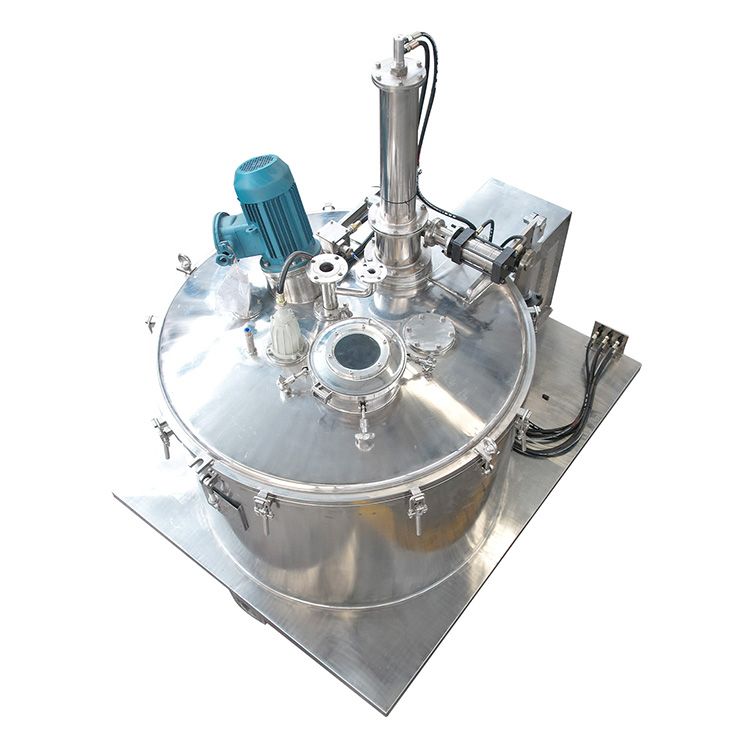
A centrifuge separates solids from liquid by centrifugal force, and that principle does not change between industries. What changes is the penalty for getting the boundary conditions wrong. In chemical service three failure modes dominate, and each one is decided at specification stage rather than at commissioning.
- Corrosion of wetted parts. Chloride-bearing streams, weak alkaline brines, acids and solvent systems attack the basket, the casing and the filtrate path. A material grade chosen for “general chemical use” can be the wrong grade for one specific ion.
- Ignition risk in a hazardous area. Solvent-wet cake and flammable vapour mean the drive, the electrical components and the enclosure are part of the safety case, not accessories.
- Product loss and cross-contamination. Residue left in the basket after discharge is product that does not ship, and it is contamination in the next batch.
The commercial consequence is that the sequence matters. A buyer who selects a model first and then asks for a material upgrade usually discovers the change at the worst point in the project — after drawings are released and after the lead-time clock has started. Selecting the constraints first keeps the model decision reversible.
If the medium analysis and the area classification are not yet on paper, the model number is not yet a decision. Treat any quotation issued before those two documents exist as an estimate, not a commitment.
Industry background: standards, duty types and market signals
Filtering duty versus sedimentation duty
Industrial centrifuges split into two families. Sedimentation machines — decanters and screen-decanters — rely on density difference and settle solids against the bowl wall. Filtering machines — basket, peeler, pusher and scroll-screen types — trap solids on a screen or filter medium and dewater the cake in place.
Fortune Business Insights reports that sedimentation centrifuges held 56.6% of the industrial centrifuge market in 2025, while filtering centrifuges are forecast to grow at 7.2% annually, driven by API crystallization and specialty-chemical purification. For a chemical plant the practical reading is straightforward: filtering configurations are the growth segment precisely because crystalline and purifiable products are where cake purity, washing and dryness matter most.
The standard that governs the design file
EN 12547:2014 is the current European standard for centrifuge safety requirements. It excludes household and laboratory models covered by EN 61010-2-020, which means it applies directly to production-scale chemical equipment. When a European buyer asks whether a machine is “built to standard”, EN 12547:2014 is the reference that makes the question answerable.
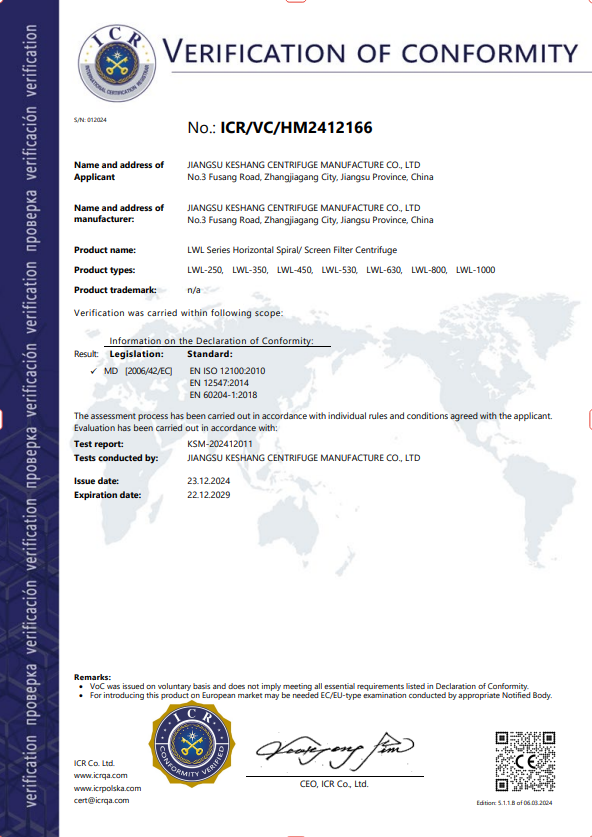
JGD Centrifuge holds a CE Verification of Conformity No. ICR/VC/HM2412166, issued by ICR Co., Ltd., valid from 23 December 2024 to 22 December 2029. The certification covers the LWL series horizontal spiral / screen filter centrifuge — models LWL-250, LWL-350, LWL-450, LWL-530, LWL-630, LWL-800 and LWL-1000 — assessed under Machinery Directive 2006/42/EC against EN ISO 12100:2010, EN 12547:2014 and EN 60204-1:2018.
Customs classification is not a specification
HS heading 8421 covers centrifuges, including centrifugal dryers, and filtering or purifying machinery for liquids or gases; subheading 842111 covers centrifuges and cream separators. These codes are useful for import planning, but they are classification tools only. HS 8421 is broader than industrial centrifuges and cannot be used as a proxy for equipment capability when comparing suppliers.
The five constraints JGD Centrifuge configures against
1. Wetted-material grade
Material grade is the first constraint because it is the hardest to change later. Across the JGD Centrifuge range, the listed construction options are SS304, SS321, SS316L, SS2205, SS904L, titanium and Hastelloy-C alloy. Specific models carry specific contact-material statements: the LGZ1250 lists SS316L and SS904L as contact-material options; the PGZ1000 and PD1250 can be supplied with 316L stainless steel wetted or contact parts; the PLQ1250 and PSLQ800 list SS316L among available materials.
The selection logic published in JGD's own application guidance is a starting filter, not a final answer: SS304 for normal working conditions; SS316L for moderate corrosion; Hastelloy or PTFE lining for strong corrosion; and ordinary SS304 should be avoided where the medium contains chloride ions. A 316L stainless steel industrial centrifuge is therefore the middle of the range, not the top of it — which is exactly where many fine-chemical duties land, and exactly why the medium analysis has to be specific.
2. Explosion protection
Every model in the current JGD range is specified with an explosion-proof main motor, with ratings that scale by drum size and duty: 3 kW on the PSB600, 5.5 kW on the PSLQ800, 11 kW on the PGZ1000 and HR400, 18.5 kW on the PD1250, 22 kW on the LGZ1250, PLQ1250 and LWL450, 30 kW on the HY1200, 37 kW on the GK1000, and a 15–22 kW range on the LW350 decanter.
The motor is one element of the safety case, not the whole of it. Area classification also drives the electrical component set, the enclosure sealing and the instrument selection. The published ODM customization scope covers supply voltage, electrical component brand (PLC and touch screen, frequency converter, motor) and bearings — which means the electrical bill of materials is a specification input the buyer is expected to define.
3. Enclosure and cleanability
Where batches change and products must not carry over, cleanability is a performance parameter. The PSLQ800 is described as having cGMP sanitary construction, cGMP/CIP compatibility and no dead corners. The PLQ1250 uses a fully openable lid intended to support cGMP cleaning and hygiene requirements. The PSB600 is described as having no hidden areas that are difficult to clean and needing no base installation. The PGZ1000 uses a flat plate damping structure that does not require a foundation, combined with a sealed and explosion-proof design.
4. Discharge method and crystal integrity
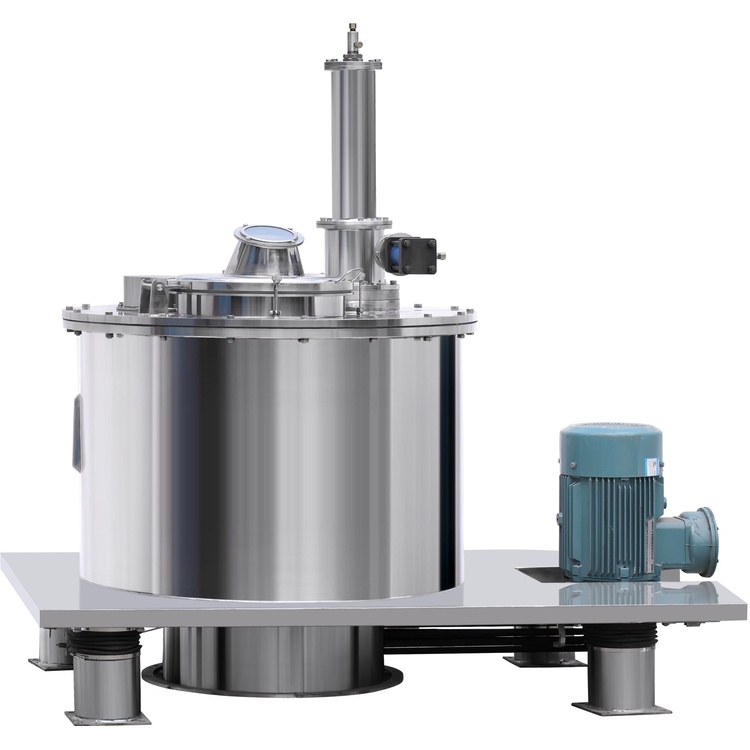
Discharge determines both product quality and operator exposure. JGD's published description of the options is precise: basic models use manual upper shovelling; bag-lifting models discharge by lifting the filter bag directly; LGZ/PGZ models use a fully automatic scraper for bottom discharge. The PLQ1250 uses an automatic pull-bag design in which the filter cake is discharged automatically, and its discharge method is intended to avoid scraping action against the filter cake in order to limit crystal abrasion.
For fragile crystals the distinction matters. The PSB600 is described as having zero crystal breakage and extremely gentle handling on particles. The pusher types avoid mechanical abrasion from a blade entirely: the HR400 uses piston-based material pushing, and the HY1200 uses a piston-based discharge without scraping or cutting wear.
5. Operating continuity
Batch and continuous machines are not interchangeable once the plant schedule is fixed. The continuous configurations in the JGD range are the LWL450 scroll discharge screen centrifuge at 20 m³/h feed, the LW350 decanter, the LLWZ450 screen-decanter, and the HY1200 and HR400 pusher centrifuges. The LWL450 is described as fully continuous operation with a 1570 maximum separation factor; the HY1200 is described as true fully continuous, uninterrupted operation with hydraulic drive and high single-unit capacity.
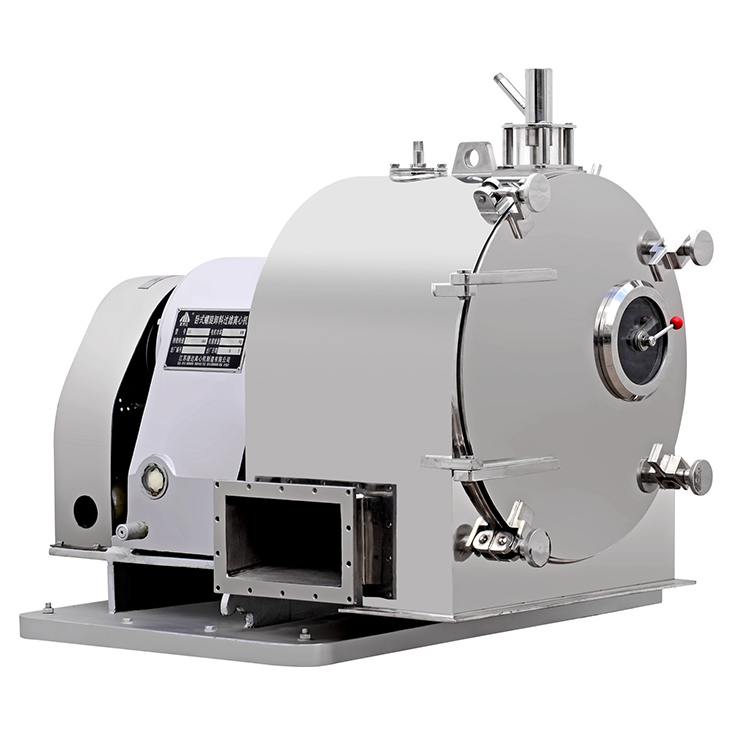
The batch configurations are the PSB600, PSLQ800, PGZ1000, GK1000, LGZ1250, PLQ1250 and PD1250. For a plant running multi-product campaigns, batch is usually the correct answer; for a single-product line running around the clock, continuous is usually the correct answer. The wrong pairing produces either idle capacity or a scheduling bottleneck that no amount of motor power will fix.
Step-by-step: fixing the specification before requesting a quotation
Record the liquid phase, the dissolved salts and the pH band. The JGD reference case for the Chilean lithium carbonate project is a useful template: a weakly alkaline system containing Na⁺, SO₄²⁻ and Cl⁻, with 10–30% solids in the precipitated slurry, which drove the requirement for SS2205 duplex stainless steel.
Select from SS304, SS321, SS316L, SS2205, SS904L, titanium and Hastelloy-C alloy. Do not accept “stainless steel” as an answer; the grade has to be named, because the same drum diameter is offered in several grades.
The explosion-proof main motor is standard across the range, but the electrical component brands, enclosure sealing and instrumentation are configuration items. Specify them at RFQ stage, not at drawing approval.
Manual top discharge, bag-lifting, automatic pull-bag, scraper bottom discharge or piston pushing. Each has a different effect on crystal integrity, operator exposure and cycle time.
Continuous types: LWL450, LW350, LLWZ450, HY1200, HR400. Batch types: PSB600, PSLQ800, PGZ1000, GK1000, LGZ1250, PLQ1250, PD1250.
The separation factor expresses centrifugal separation capability; a higher value means stronger separation. JGD's published guidance is 800–1200 for crystalline materials, increased appropriately for fine particulates, and deliberately not pushed too high for fragile materials to prevent particle breakage.
Two drums of the same diameter can have different loading capacities because the effective drum depth and the rated loading limit differ. The rated loading limit governs; overloading causes violent vibration and a safety hazard. For reference, the LGZ1250 is rated at 400 L and 530 kg maximum load, the GK1000 at 165 L and 225 kg, and the PSB600 at 40 L and 60 kg.
Name the certificate, the standard and the test. JGD performs a no-load test before delivery and states 30–60 days lead time from a minimum order quantity of 1 unit.
Where these constraints have been applied
Corrosive brine duty: lithium carbonate in Chile
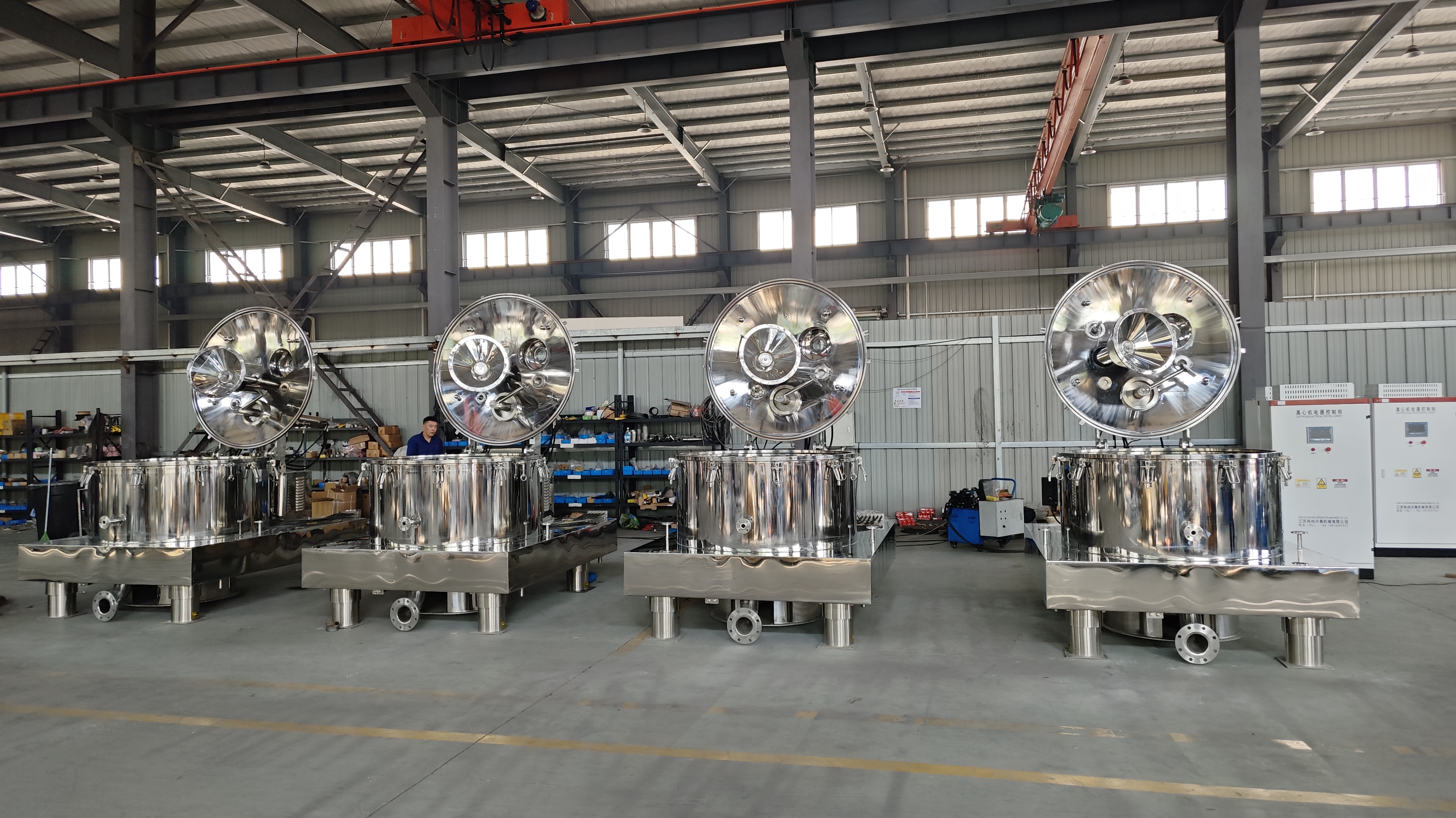
A chemical plant in Chile recovering lithium carbonate from Atacama salt-lake brine runs four LGZ1250 vertical bottom discharge scraper centrifuges. The working condition is a weakly alkaline system containing soluble Na⁺, SO₄²⁻ and Cl⁻ salts with 10–30% solids, which is why SS2205 duplex stainless steel was specified rather than a standard austenitic grade. The installation also required a CIP online cleaning system and strict solid-liquid separation precision for crystal recovery.
The reported result after ten years of operation is stable running with low noise, separation performance that meets the capacity requirement, and reduced labour cost. That case is useful precisely because it shows the constraint logic working in sequence: the chemistry forced the material, the material and duty forced the model, and the model then delivered the operating result.
Crystalline salts and fertilizer intermediates
Batch basket centrifuges are described as suitable for solid-liquid separation of granular and crystalline materials, including salt crystals, chemical intermediates, resins, food additives and plant extracts. In this duty the machine has to protect the crystal as much as dewater it, which points to piston-pushing or bag-lifting discharge rather than a scraping knife.
The HY1200 single-stage pusher is the high-capacity option here: 1200 mm drum diameter, 130 kg maximum loading, 500 rpm, separation factor 170, 30 kW explosion-proof motor, and a penetrating wash that supports product purity with high cake dryness. The HR400 double-stage unit works the finer end of the same duty with a two-stage stepped dewatering design that the supplier describes as halving axial pushing resistance while widening the particle-size window.
Pharmaceutical and API crystallization
Fortune Business Insights reports that approximately 57% of pharmaceutical manufacturing plants have adopted horizontal scraper centrifuges, which indicates how dominant that configuration has become for API crystallization. The JGD equivalents are the GK1000 horizontal peeler and the LGZ1250 vertical scraper; the PSLQ800 covers the cGMP-critical subset with cGMP sanitary construction, cGMP/CIP compatibility and no dead corners, and the PD1250 covers containment-critical duties with 1250 mm drum diameter, 400 L volume and 530 kg maximum load.
Model comparison by locked constraint
The table below uses only published specification values for JGD Centrifuge models. It is organised so that the constraint columns — material grade, motor protection and duty type — can be read before the performance columns.
| Model | Type | Drum dia. | Volume / max load | Drum speed | Max separation factor | Main motor | Duty |
|---|---|---|---|---|---|---|---|
| PSB600 | Manual top discharge basket | 600 mm | 40 L / 60 kg | 1500 rpm | 755 | 3 kW, explosion-proof | Batch |
| PSLQ800 | Full-opening lid manual top discharge | 800 mm | 100 L / 135 kg | 1200 rpm | 645 | 5.5 kW, explosion-proof | Batch |
| PGZ1000 | Vertical bottom discharge peeler | 1000 mm | 175 L / 235 kg | 1000 rpm | 560 | 11 kW, explosion-proof | Batch |
| GK1000 | Horizontal peeler | 1000 mm | 165 L / 225 kg | 1350 rpm | 1020 | 37 kW, explosion-proof | Batch |
| LGZ1250 | Vertical bottom discharge scraper | 1250 mm | 400 L / 530 kg | 1000 rpm | 700 | 22 kW, explosion-proof | Batch |
| PLQ1250 | Vertical automatic pull-bag discharge | 1250 mm | 300 L / 400 kg | 1000 rpm | 700 | 22 kW, explosion-proof | Batch |
| PD1250 | Top discharge bag-lifting | 1250 mm | 400 L / 530 kg | 960 rpm | 645 | 18.5 kW, explosion-proof | Batch |
| HR400 | Horizontal double-stage pusher | 337 / 400 mm | Filter length 145 / 155 mm | 1600 rpm | 545 / 645 | 11 kW, explosion-proof | Continuous |
| HY1200 | Horizontal single-stage pusher | 1200 mm | Filter length 500 mm / 130 kg | 500 rpm | 170 | 30 kW, explosion-proof | Continuous |
| LWL450 | Horizontal scroll screen discharge | Feed 20 m³/h | Not applicable | 2500 rpm | 1570 | 22 kW, explosion-proof | Continuous |
| LW350 | Horizontal decanter | 350 mm, length 1550 mm | Not applicable | 3700 rpm | 2683 | 15–22 kW, explosion-proof | Continuous |
| LLWZ450 | Horizontal screen-decanter | 450 mm large-end bore | L/D 2.5–3.8 | 2800–3200 rpm | 2000–2500 | Not listed for this model | Continuous |
All values as published for the respective JGD Centrifuge models. Where a value is not stated for a given model, it is marked accordingly rather than estimated.
Construction material options and documented selection notes
| Material option | Documented selection note |
|---|---|
| SS304 | Stated for normal working conditions; ordinary SS304 should be avoided where the medium contains chloride ions. |
| SS316L | Stated for moderate corrosion. Available as a contact-material option across the basket, peeler and decanter range; a 316L supply supports corrosive chemical processing when 316L contact parts are specified. |
| SS321 / SS2205 / SS904L | Listed construction options. SS2205 was specified for the Chilean lithium carbonate installation, a weakly alkaline chloride-bearing system. LGZ1250 lists SS904L as a contact-material option. |
| Titanium / Hastelloy-C alloy | Listed options intended for corrosive media; Hastelloy or PTFE lining is the stated route for strong corrosion. |
Frequently asked questions
1. How do JGD Centrifuge units address CE and ATEX compliance for a chemical plant?
The certification record for this range is a CE Verification of Conformity No. ICR/VC/HM2412166, issued by ICR Co., Ltd. and valid from 23 December 2024 to 22 December 2029. It covers the LWL series horizontal spiral / screen filter centrifuge in models LWL-250, LWL-350, LWL-450, LWL-530, LWL-630, LWL-800 and LWL-1000, assessed under Machinery Directive 2006/42/EC against EN ISO 12100:2010, EN 12547:2014 and EN 60204-1:2018. EN 12547:2014 is the European safety standard for centrifuges. Explosion-proof main motors are specified on the models listed in this article. Where a plant requires ATEX documentation or a declaration tied to a specific motor, enclosure and material combination, that requirement should be written into the RFQ so the declaration is issued against the exact ordered configuration rather than assumed.
2. Which material should be specified for a corrosive chemical medium?
The published guidance is SS304 for normal working conditions, SS316L for moderate corrosion, and Hastelloy or PTFE lining for strong corrosion, with ordinary SS304 avoided where the medium contains chloride ions. Available construction options across the range are SS304, SS321, SS316L, SS2205, SS904L, titanium and Hastelloy-C alloy. Model-level statements are more specific than the range-level list: the LGZ1250 lists SS316L and SS904L as contact-material options, and the PGZ1000, PD1250 and PLQ1250 can be supplied with 316L stainless steel contact or wetted parts. The correct input is a written medium analysis, not a general description such as “acidic”.
3. What is the minimum order quantity, and which configuration items drive the quotation?
JGD Centrifuge states a minimum order quantity of 1 unit. The published ODM customization scope covers supply voltage, electrical component brand (PLC and touch screen, frequency converter, motor) and bearings. Those items, together with the wetted-material grade, the discharge method and the explosion-protection requirements, are the variables that have to be fixed before a configuration-specific quotation can be issued.
4. Can a plant validate the machine before committing to a full production line?
The stated commercial terms support a single-unit first order, since the minimum order quantity is 1 unit. Every unit receives a no-load test before delivery, and remote support is provided after shipment. For plants that need to prove a separation result on their own medium, the practical route is to define the acceptance parameters — material grade, separation factor band, cake dryness target — in the order documentation so the no-load test and the on-site commissioning are both measured against the same specification.
5. What is the lead time, and what happens after delivery?
Lead time is stated at 30–60 days, against a monthly capacity of 8 units at the Zhangjiagang factory. After-sales support is provided remotely. Because part of the lead time is consumed by material and electrical-component procurement, the constraint set should be closed before the order is placed — a material grade changed after release restarts part of that 30–60 day window. To start that process, send the medium analysis, the required capacity and the area classification to the JGD Centrifuge technical team at sales@jgdcentrifuge.com.
Conclusion: close the constraints, then choose the model
An industrial centrifuge for the chemical industry is not selected by comparing drum diameters in isolation. The sequence that holds up under audit is: medium analysis, then wetted-material grade, then explosion protection and electrical specification, then discharge method and cleanability, then batch or continuous duty — and only then the model, the separation factor and the motor rating.
The JGD Centrifuge range covers that full constraint map: seven construction material options including SS316L, SS2205, titanium and Hastelloy-C alloy; explosion-proof main motors from 3 kW to 37 kW; batch machines from a 600 mm manual basket to a 1250 mm automatic scraper; continuous machines including the LWL450 at 20 m³/h and the LW350 decanter at a 2683 maximum separation factor; and a CE Verification of Conformity covering the LWL-250 through LWL-1000 series.
What a buyer should take away is narrower than a product list. Fix the constraints in writing, name the certificate and the standard, state the loading limit rather than the drum volume, and treat the quotation as the last step rather than the first. Everything else — model number, motor size, separation factor — becomes a consequence rather than a guess.
Next step: send the medium, get the configuration
Share your medium analysis, solids content, required capacity and area classification, and the JGD Centrifuge team will return a model recommendation with the matching material grade, motor rating and discharge method.
Contact: Jay Wang · sales@jgdcentrifuge.com · Tel / WhatsApp +86 159-9546-3675 · No.2, Lefeng Road, Leyu Town, Zhangjiagang City, Jiangsu Province, China · www.jgdcentrifuge.com
Download the JGD Centrifuge product catalogue (PDF)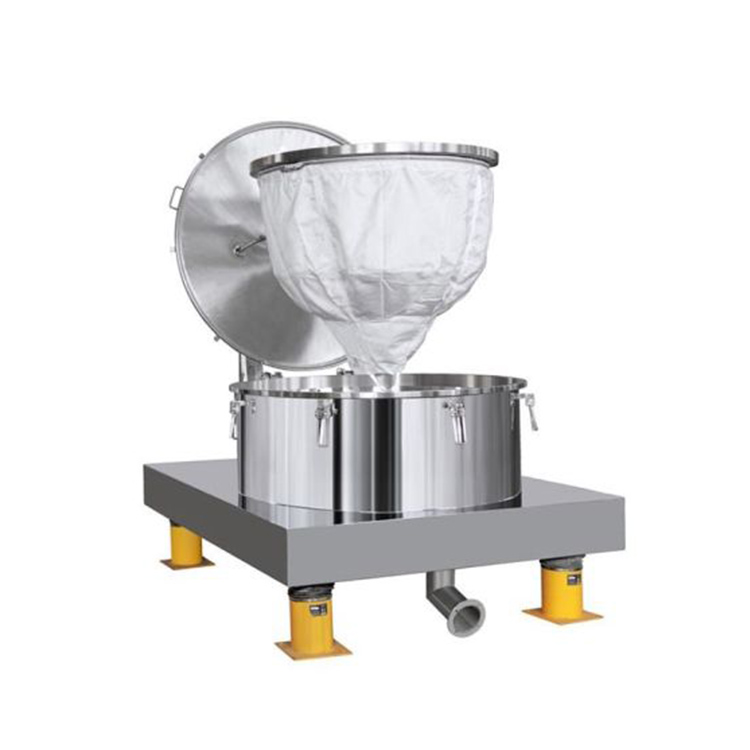
Have Questions or Need More Details?
Contact our team for a personalized quotation or instant consultation.
Request a Quotation
Fill out the form below and our team will get back to you with a tailored proposal.
WhatsApp Direct Chat
Prefer to chat in real-time? Message us on WhatsApp for instant assistance & quick answers.
- Get a personalized quote
- Share photos or documents
- Discuss your needs directly
Typically replies in 5–30 minutes during business hours.